
A Detailed Introduction to IB
Where the International Baccalaureate came from, what it actually is, how the diploma is built, and how it is assessed.
The Development History of the IB Program
The IB program was developed by a group of international educators in Geneva, Switzerland, in the early to mid-1960s. Following the demand at the International Conference in 1945 for the creation of an international school in Geneva, Robert Leach organized a meeting in Geneva in 1962 and introduced the term "International Baccalaureate."
It wasn't until 1968 that the IB headquarters was officially established in Geneva, with 12 schools from 12 countries joining the IBDP program that same year, including UWC Atlantic College and the United Nations International School in New York. The IBDP became the first program offered by the IBO, catering to students aged 16 to 19.
In the initial six years of the IBDP program, student enrollment was limited, and each IB school had to undergo supervision and inspection by ISES/IBO and obtain government approval. From the outset, all subjects of the IBDP were available in both English and French, and all students were required to take both a first and a second language. After the six-year pilot program ended in 1975, the IB program not only had its own curriculum and official assessment schemes but also established a bilingual diploma.
In 1980, the IBO hosted a workshop in Singapore, officially incorporating Asian culture and education into the IB curriculum.
What exactly is the IB program?
The IB program is a highly popular international curriculum choice among students, often referred to as one of the "challenging international high school systems." However, it extends beyond high school and encompasses a complete international curriculum system from kindergarten to high school graduation, catering to students aged 3 to 18. It can be said that "IB accompanies you as you grow."
Initially created for students living and studying across countries, the IB program aims to provide them with a globally unified education system and curriculum. This ensures that students in the IB system can smoothly transition to local IB schools when returning to their hometowns or relocating to another country during their studies.
The IB curriculum comprises three different stages of learning: the PYP for grades one to five, the MYP for grades six to ten, and the DP for grades eleven to twelve. The final stage, the IBDP, provides internationally recognized qualifications for undergraduate education, namely the IB Diploma, which is widely accepted by many universities worldwide.
Today, when we hear about the IB program, it often refers to the IBDP (International Baccalaureate Diploma Programme) in high school. The IBDP is a two-year education program managed and operated by the International Baccalaureate Organization (IBO) to maintain academic standards consistently.
Students enrolled in the IBDP must study and participate in both internal and external assessments at their schools to obtain the high school diploma. They cannot obtain the IB diploma through home study or training at educational institutions. To offer the IB diploma, schools must be authorized and certified by the IBO as an IB school.
IBDP Curriculum Structure
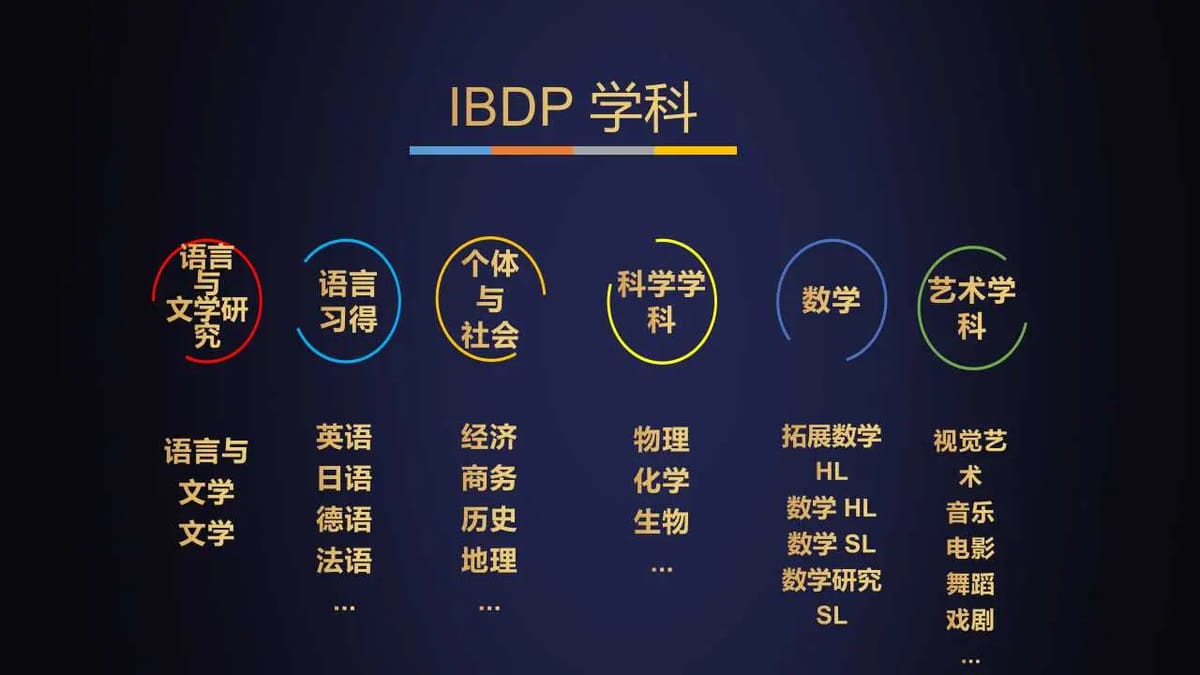
The IBDP curriculum comprises three core courses and six subject groups, ensuring students study both science and humanities subjects. All students participating in the IBDP must choose one course from each of the six subject groups. If the arts course in the sixth group is not available, students may choose one from groups one to five as an alternative. The specific course offerings may vary among IB schools, and not all subjects approved by the IBO may be offered. Therefore, it is essential to understand the specific course offerings of the IB school's DP stage beforehand.
The three core courses include: Theory of Knowledge (TOK), Extended Essay (EE), and Creativity, Activity, Service (CAS), aiming to encourage students to reflect on the nature of knowledge, conduct independent research, and engage in a project typically involving community service.
Theory of Knowledge (TOK) aims to make students aware of the interpretive nature of knowledge, critically reflecting on different ways of knowing and knowledge domains, considering the role and nature of knowledge in their own culture, other cultures, and the broader world; The Extended Essay (EE) requires students to choose a topic, conduct exploration, independently formulate research questions and essay content, and ultimately produce a customized essay; Creativity, Activity, Service (CAS) encourages students to engage in at least 150 hours of group activities, including drama, music, sports, and community service, such as serving in the community, nursing homes, kindergartens, volunteering, talent performances, or teaching skills.
Additionally, the six subject groups under the IBDP core curriculum are further divided into different subjects. Each subject is divided into Standard Level (SL) or Higher Level (HL) or both, with the IBDP requiring students to study at least 3 HL subjects.
Group 1: Studies in Language and Literature (usually the student's mother tongue), divided into Language A: Literature (SL/HL), Language A: Language and Literature (SL/HL), Literature and Performance (SL);
Group 2: Language Acquisition, divided into Language Ab Initio (SL), Language B (SL and HL), Classical Languages;
Group 3: Individuals and Societies, divided into Business Management (SL/HL), Economics (SL/HL), Geography (SL/HL), Global Politics (SL/HL), History (SL/HL), ITGS (SL/HL), Philosophy (SL/HL), Psychology (SL/HL), Social and Cultural Anthropology (SL/HL), World Religions (SL);
Group 4: Sciences, divided into Biology (SL/HL), Chemistry (SL/HL), Physics (SL/HL), Design Technology (SL/HL), Environmental Systems (SL/HL), Sports, Exercise and Health Science (SL/HL);
Group 5: Mathematics, divided into Mathematics: Analysis and Approaches (SL/HL), Mathematics: Applications and Interpretation (SL/HL), students can only choose one, the Mathematics group has undergone curriculum reforms starting from August 2019, with the first assessment test conducted in May 2021.
Group 6: Arts/Electives (students may choose additional subjects from groups 2, 3, or 4 instead of arts). Arts include Dance (SL/HL), Film (SL), Music (SL/HL), Theatre (SL/HL), and Visual Arts (SL/HL).
Additionally, with IBO approval, schools can design new courses and syllabi according to their needs and teaching resources. However, this is limited to the Standard Level only, such as interdisciplinary subjects: Environmental Systems and Societies, Literature and Performance.

Assessment Methods in the IBDP
To obtain the IB Diploma, students must choose a minimum of 3 SL and 3 HL subjects from the six subject groups, with each subject scored out of 7 points. The total score for the six subjects is 42 points, plus 3 points for the Extended Essay (EE) and Theory of Knowledge (TOK), making a total maximum score of 45 points for a complete IBDP. The minimum passing score for obtaining the IB certificate is 24 points, with scores typically above 38 points considered high.
Assessment of subject subjects in the IBDP involves both internal and external evaluations. Internal assessments vary depending on the topics chosen by students: they may include oral presentations, practical work, or written work. In most cases, these assessments are initially conducted by classroom teachers. For example, in the Science group, such as Biology, the teacher assesses students based on their performance, assignments, unit tests, mid-term exams, lab skills, lab reports, and comprehensive projects. These scores are then verified or modified by designated external coordinators.
External assessments occur at the end of the DP, where schools use external assessments to evaluate students' abilities, commonly known as the final exams. These exams are divided between the southern and northern hemispheres, with Chinese students typically taking the exams in May (southern hemisphere countries primarily take them in November). These exams are pen-and-paper. For example, Biology includes: SL: P1P2P3, HL: P1P2P3, for a total of 6 papers, in addition to the internal assessments for SL and HL. The final score for IB Biology is then calculated based on these assessments.
The assessment method for the TOK core course involves a 10-minute oral presentation and a 1600-word essay, with students choosing one of the six essay titles published by the IB. The topics change for each exam session, and students are also required to participate in speeches, either individually or in groups of up to three. The EE essay is assessed by external IB examiners based on uniform standards. The final score is determined by the combined assessment of the EE and TOK.
Although CAS courses are not part of the grading system, they are an essential element of the IBDP. Each activity has a supervisor who monitors and guides the activity, recording and evaluating the students' participation. In addition, IB students must keep a CAS activity diary, recording their thoughts and insights. In this way, CAS activities may indirectly affect internal assessments.

Advantages of the IB Program
The IB program is not based on the curriculum of any country in the world but stands alone, drawing extensively from the strengths of mainstream curriculum systems in many developed countries, covering their core content. Its system is both compatible with mainstream education curriculum systems worldwide and has its own uniqueness under the development of its educational philosophy.
As the IB programm is primarily taught by foreign teachers and English, French, or Spanish is the main teaching language, the fully English-immersed environment enhances students' proficiency and authenticity in English language learning, leading to a deeper understanding of cultural differences among nations, thus facilitating the cultivation of children with diversity and adaptability. In the increasingly globalized society of the future, IB students demonstrate more obvious advantages in career and development choices, language, and cultural understanding.
Furthermore, the educational philosophy of the IB program is "Education for Life," emphasizing holistic education. Due to its unique assessment methods, IB students are not merely "learning machines" focused solely on "grades," but rather are encouraged to cultivate independent thinking and decision-making abilities, fostering individuality and critical thinking skills.
Through a diverse range of extracurricular activities and opportunities for international travel and exploration, the IB program encourages students to experience life fully, helping schools to strive to cultivate students' global citizenship awareness and encouraging them to explore more of the unknown world.
Overall, the IB program is widely recognized for its high academic standards and challenging curriculum by the global education community. Currently, over four thousand universities worldwide recognize the IB Diploma, spanning more than a dozen countries, with extremely high recognition rates.